BIOSPHERE 2 + FRANKE HONORS
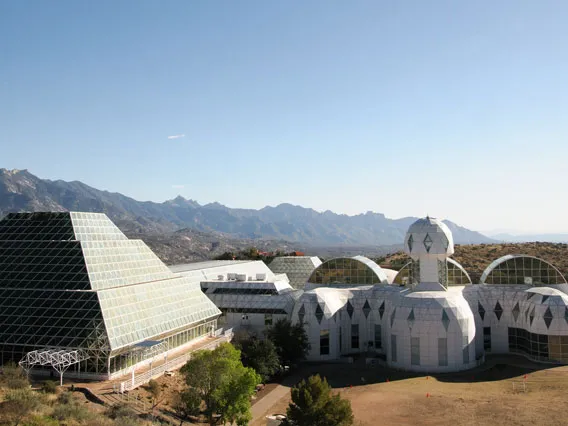
Franke Honors students have the opportunity to participate in hands-on learning through partnerships with Biosphere 2, a one-of-a- kind 3.14-acre living laboratory where cutting-edge research unfolds across diverse ecosystems—including a rainforest, ocean, mangrove, desert, and the Landscape Evolution Observatory.
VIP Research Experiences at Biosphere 2
Vertically Integrated Projects (VIP) bring together teams of undergraduate students — from various years, disciplines, and backgrounds — to work with faculty and graduate students in their areas of scholarship and exploration. Undergraduate students earn academic credit or pay for their work and have direct experience with the innovation process. We highly encourage honors students to participate in a VIP!
Biosphere 3 is not simply another initiative. It is the platform where humanity learns to make worlds habitable—beginning with Earth, extending to Mars, embodied in autonomous systems that transcend human limitations.
Be part of a team of pioneering researchers building the technology that will grow food on Mars, training the AI systems that will maintain Earth’s climate resilience, and creating the scientific methodology that will accelerate discovery across every domain where complex systems require understanding and intervention.
Franke Honors students have a unique opportunity to earn honors units through a Vertically Integrated Project while participating in research, design, and development related to Biosphere 3—a digital twin of Biosphere 2 that will be used to conduct experiments and train physical AI.
Issues Involved or Addressed:
- How can we rapidly prototype and bring to market a scientifically rigorous virtual replica of Biosphere 2's built environment, its sensors and living biomes?
- What are the implications for humans and our natural world of artificial intelligence with spatial awareness, mobility, and autonomy?
- How can we make science and technology more understandable through communications?
Sound interesting?
Franke Honors students can receive up to 3-units per semester over multiple semesters for participation by enrolling in HNRS 392H.
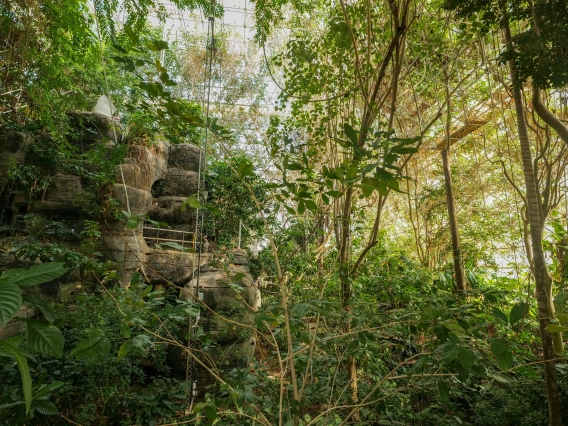
The Biosphere 2 rainforest—experiencing canopy temperatures well beyond what any Biosphere 1 rainforest experiences—is uniquely suited to determine long-term ecosystem and individual responses to climate change. Furthermore, it provides a fantastic testing ground for research tools to investigate tropical forest ecosystems.
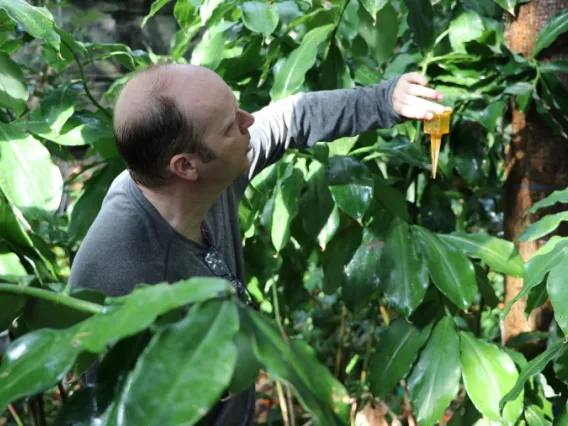
Join Franke Honors Professor Joost van Haren to capture and communicate ecosystem responses to climate change.
Basic courses for the Rainforest Resilience VIP will include:
- Honors Internship (3 units), which guides students through a research project from idea through proposal and research to presentation in one semester. The internship also examines the scientific method, how it and the scientific results are communicated within the science community as well as to the general public.
- A basic tropical forest seminar, featuring student-led discussing papers on a wide range of topics, including ecosystem carbon and water cycling, influences on tropical forest species distributions, tropical forest climate, human impacts on tropical forests.
Issues Involved or Addressed
In the rainforest, we have the capacity to include students in projects that investigate these responses at multiple levels, asking questions such as:
- How does ecosystem carbon and water exchange impacted by climate change, such as increased temperature or drought?
- How is photosynthesis impacted by increases temperature or vapor pressure deficit?
- What different strategies do tropical forest plants have to manage water and how do we best measure those?
- What are the environmental drivers of greenhouse gas emissions from tropical forest stems and soils?
To address questions like these we have: 1) long-term environmental data collected and stored in the Biosphere 2 database, 2) datasets collected during previous experiments that can be (re)analyzed, and 3) instrumentation (or connections for short-term loans) to make new measurements.
The main goal of this team is to provide students at multiple stages in their academic career an opportunity to be involved in, and lead, research in the Biosphere 2 rainforest, and be involved in discussions about tropical forests in general. Students may include Biosphere 2 Honors Interns, Honors thesis students, and Carson Scholars (both undergraduate and graduate), as well as other motivated students.
Sound Interesting?
To express interest in this team, please complete the VIP Interest Form and select "Biosphere 2 Rainforest Resilience."
The Wonder Studio at Biosphere 2 is where animation, film, and data visualization come together to tell powerful stories about our world and research. We’re more than just studio — we’re a creative lab, a launchpad for innovation, and a place where science meets imagination.
Whether you're an artist, a scientist, an engineer, or just someone who loves to tell stories, The Wonder Studio is your space to explore bold ideas, experiment with new media, and push the boundaries of science communication.
We believe that data can be beautiful, that research deserves an audience, and that storytelling has the power to change how we see the world. Through immersive films, animated visuals, and cinematic storytelling, we make complex ideas accessible, engaging, and unforgettable. Join us in shaping the future of creative science communication!
Issues Involved or Addressed
This studio/laboratory addresses:
- The need for immersive experiential learning opportunities for students, faculty, staff, and community members to develop a deeper sense of wonder and awe for our natural world
- A void in creative science communication as a field of research that incorporates humor, data, and cinema-inspired storytelling into the way we explore, illustrate, and communicate our research
- A desire to create unique student workforce development experiences for future hyper-dynamic careers across creative arts, science, engineering, marketing, and technology disciplines
- An opportunity to make University of Arizona research more impactful through community-engaged outreach projects and storytelling
Sound Interesting?
To express interest in this team, please complete the VIP Interest Form and select "Biosphere 2 Wonder Studio."
Coral reefs are the “rainforests” of the ocean. They make up only a tiny percentage of the world's ocean area but are home to more than 40% of marine fish species. Understanding and managing the effects of climate change and human impacts on the world’s oceans are critical challenges for the 21st century.
The goal of this VIP is to understand the interaction of biotic and abiotic factors on the physiology of corals. The labs of Jeremiah Hackett and Diane Thompson take complementary approaches from the fields of biology and geosciences to understand how corals will be affected by future climate change and what we can do to promote their resiliency.
Dr. Hackett is interested in the molecular interactions among the three groups of organisms that comprise healthy coral reefs: bacteria, algae and coral animals. Dr. Thompson is interested in how these interactions, as well as abiotic variables, like temperature and acidity, affect the chemistry of the calcium carbonate skeletons produced by corals.
Sound Interesting?
Please complete our Coral Reef Resilience VIP Application if you are interested in joining at this time.
Earning Honors Units for a VIP Research Experience
VIPs are open to Franke Honors students, as well as other undergrad and graduate students. To earn honors units for your VIP, follow these steps:
- Apply for the VIP you are interested in
- Once accepted, you can either:
- Fill out the honors Independent Study Form to enroll in an HNRS section for research units
- Enroll in research units through your primary major department. To earn honors credit for those units, you will need to work with your major department to ensure you're enrolled in an honors section of those units.
- If you have questions or want to verify you are properly enrolled, please contact:
- Kay Orzech, Program Coordinator, Vertically Integrated Projects, kmcelvee@arizona.edu
- Tori Nardinelli, Assistant Director of Research, Creative Expression and Professional Initiatives, Franke Honors College, outfleet@arizona.edu
Want to Learn More about Vertically Integrated Projects?
A VIP at Biosphere 2 is an amazing opportunity for a Franke Honors Wildcat, but there are dozens of exciting research opportunities offered through VIP that span multiple disciplines.
Franke Honors Courses + Biosphere 2
HNRS 170A1: Sensing Our Environment
How does our environment shape our relationship with the planet? See, hear, smell, feel and taste your way through Tucson as the city becomes your classroom. Students will design an experiment inside Biosphere 2.
HNRS 219: Our Human Footprint
Learn how to analyze and communicate human drivers of impact on the planet, exploring topics such as resource use, species extinction and transportation systems.
HNRS 195I-001: Biosphere 2: Without It We Are Just Living the Experiment
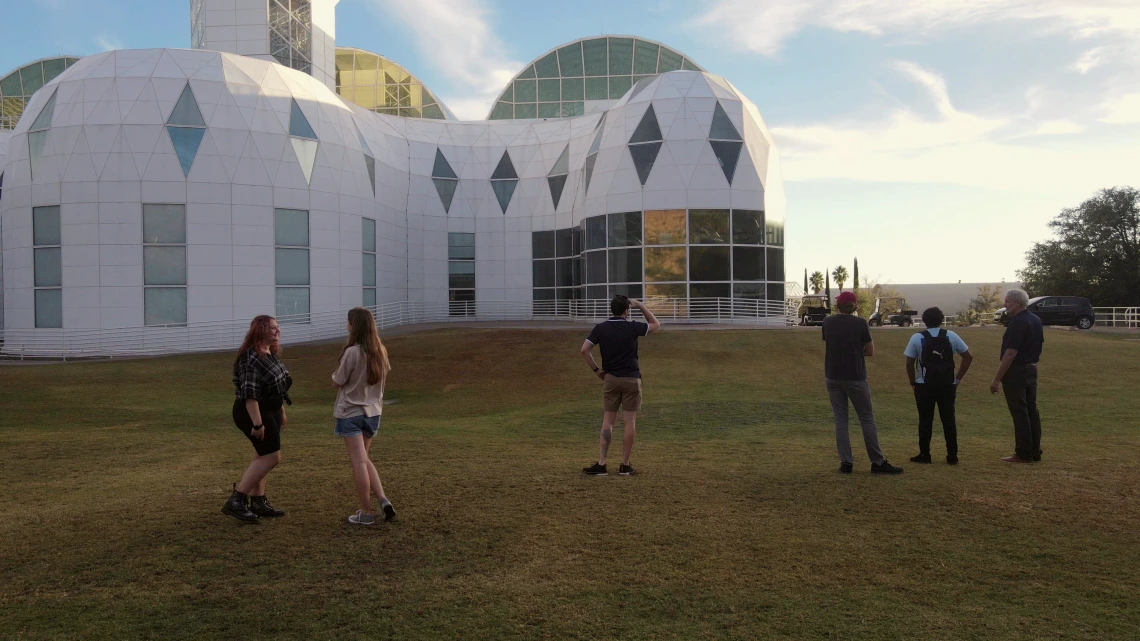
Learn about current research at Biosphere 2 and its implications for our planet. This seminar includes a field trip to Biosphere 2 early in the semester and guest speakers from different times in the Biosphere 2 history.