

Franke Honors senior, 19, funds groundbreaking research through Exploratory Mini Grant

Maya Leonard shares about her research at a Galileo Circle celebration. The College of Science Galileo Circle awards scholarships to outstanding undergraduate and graduate students who show exceptional potential in the physical, mathematical, environmental, cognitive, or life sciences.
Maya Leonard will graduate from the W.A. Franke Honors College this spring with honors in Neuroscience & Cognitive Sciences (with a computation emphasis) and Molecular & Cellular Biology. Not only will she be completing two honors theses in her respective majors, she will also be doing so at the age of 19.
“As a kid I always loved looking at biology pictures and books,” said Leonard. “I was really interested in the visual side of biology, which funny enough is kind of getting into my future career plans.”
Research Beginnings
Maya grew up in the Phoenix area and received her primary education in the Deer Valley School District, where she was a part of the Renaissance Academy, a program which is founded on interdisciplinary studies, academic depth and complexity, and critical and creative thinking.
It was through Renaissance that Maya developed an early interest in academic research, getting opportunities to dive into topics that piqued her interest. In third grade it was black holes, but in middle school, Leonard started to really dive into bio topics.
When searching for her next research topic, Maya decided to focus on Alzheimer's Disease. Her grandmother had been diagnosed when Maya was very young, and she spent her childhood visiting her in a memory care home.
“Seeing my grandmother's behavior was both fascinating and terrifying. This was when I became super interested in neuroscience. In sixth grade, I ended up writing a 27-page paper on the amyloid cascade hypothesis for Alzheimer’s disease,” she said.
Little did she know that this would ignite a love for biology and neuroscience, and that it would become the foundation for her future academic career at the University of Arizona.

Maya working on a bacterial project for UBRP in summer 2024.
Charting New Territory
After graduating high school as Valedictorian at age 16 and starting at the U of A just after her seventeenth birthday, Maya’s curiosity grew as she got involved in wet lab research, participating as a student researcher in the Undergraduate Biology Research Program (UBRP).
It was through UBRP that Maya got connected to her current research with the Schlenke Lab.
Her research, which she has funded through the College of Science’s Galileo Scholarship and the Exploratory Mini-Grant program at the W.A. Franke Honors College, involves experiments with fruit flies, and is also the basis for her honors theses.
One of Maya’s projects involves working on a novel methodology for transplanting tissue on fruit flies. Using 3D printed parts, she sharpens borosilicate glass needles by hand to prevent the fly tissue from being damaged during the transplant.
The needle sharpening is both simple and complex. The tissue pull involves a micromanipulator and electrical needle apparatus to create tiny glass constrictions—smaller than the naked eye can see.
Prior to developing these methods, Maya said, there had been little to no research on effectively transplanting fruit fly tissue for the past couple decades.
"Although the feasibility of the technique was demonstrated over 80 years ago, the tools they used at the time were not described in detail and/or no longer exist. Reviving the tissue transplant technique would allow new research into the immune system's role in tissue transplant rejection,” she explained.
With support from her PI, Dr. Todd Schlenke, Maya has been testing modern pressure systems and designing these new needles for the tissue transplant.
This new methodology could lead to breakthroughs in how fruit flies’, and possibly humans’, immune systems respond to pathogens, discovering treatments for autoimmune disease, and further understanding what causes transplant rejections.
“The Exploratory Mini-Grant funding was essential to ensure that this research can continue to make strides. We’ve had several successful transplants so far, and are continuing to optimize different systems,” she said.
Art Imitates Life
This spring, as she has been working toward completing her undergraduate degrees, Maya also began her accelerated masters program in Molecular & Cellular Biology at the University of Arizona.
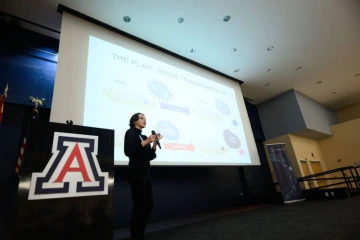
Maya shared her research at the College of Science's Galileo Circle celebration.
Through the accelerated program, she plans to complete her M. Sc. in May 2027.
In addition to her studies, Maya is also an avid artist—a passion that keeps her grounded amidst her rigorous schedule of research and academics. After she completes her masters, she hopes to either pursue a career in research or medical illustration.
“Research is certainly still on the table depending on funding, and I am really interested in molecular and cellular level modeling and interactions,” she said.
A career in medical arts would be a call back to Maya’s early biology interests, but she’s keeping an open mind as far as where her academic prowess might take her after graduation. This summer, she will be interning for her dream Neuroparasitology lab (Elya Lab) at Harvard, researching parasites that control the brain.

Franke Honors Pinnacle Symposium
Maya will present her work at the 2026 Franke Honors Pinnacle Showcase on April 22. Pinnacle is a special event that highlights incredible Franke Honors student research, including the Honors Thesis work of our Franke Honors graduating seniors and the work of Quest participants. Outstanding research will be acknowledged with financial awards.